Stage 1
The teaser worked
- What happened
- A short proof of concept made the form feel possible.
- Lesson
- Slow pacing and emotional clarity could carry the medium.
AI-assisted audio drama diary
I began with a novel called Resurrection. The experiment has become two experiments at once: learning how to make the story work as drama, and learning how to build a production system that lets one person actually make it.
The two processes keep changing each other. Better story decisions expose tool problems. Better tools let me get back to the story.
A better way to organize this diary
This is the creative process: what each episode is about, what the characters want, how much backstory an episode can carry, how Jesse/Jess changes, where the philosophy belongs, and whether a first-time listener has an emotional reason to continue.
The basic unit is increasingly the episode as a little play.
This is the production process: script structure, voices, takes, music, SFX, timing, multitrack editing, asset history, automation, databases, Codex, and the Studio application itself.
The basic goal is increasingly simple: make the machinery disappear so I can think about the story.
The history still matters because the two processes repeatedly cause one another to change. But as the project grows, the reader should be able to follow either thread separately.
Track one — story
The first finished Episode 1 taught me a painful lesson: polished voices, music, effects, and automation cannot rescue an episode that has not yet become a compelling little play.
I was trying to spend biography, philosophy, technical explanation, family history, religion, and setup as soon as each became relevant. The result contained a lot of material but not enough dramatic shape.
I now look for a beginning, middle, end; somebody wanting something; resistance; emotional investment; a turn; and a payoff. Good material can still belong in a later episode.
Episode 1a is built around attachment. The accident matters only if the listener has already started to care about Jesse, Naoko, and the life that is about to be interrupted.
The larger questions—identity, AI, love, memory, randomness, probability, faith, resurrection—do not need to arrive as lectures. They can emerge through people over the course of the series.
When I was a kid, the half-hour situation comedy was everywhere. Each show was a little play made from familiar sets and recurring characters, often with a guest character. There were really two arcs at once: the short-term problem of that episode and the long-term evolution of the people and their relationships. The Honeymooners, with Jackie Gleason, is still my favorite example.
The Dick Van Dyke Show was especially interesting because it was itself about a group that made a show. It offered a stylized look at writers, producers, actors, camera people, and the other roles inside a small troupe. Resurrection is beginning to feel oddly similar—except the troupe is essentially me and AI. The staff has disappeared, but the functions have not.
I'm learning that writing dialog is hard. Even though Chat has essentially infinite resources with respect to literature, the trick to getting it to write good dialog has been eluding both of us.
There seem to be two extremes. One is the short ping-pong exchange that Chat often likes to write. It moves quickly, but to me it can feel unnatural—not quite the way people really talk. The other extreme is the speech: one character holding the floor for too long, which can become tedious and boring.
Real conversation seems to work more through free association, almost like the subconscious voice running in our brains. A conversation touches on something briefly, that thought triggers another thought, and suddenly the speakers are talking about the new subject even though it is a diversion from where they just were.
The trick seems to be expressing those constraints properly, and I've had difficulty doing that so far. Timing matters too. Different people—and perhaps different regional or cultural styles—handle the handoff differently. Some jump in the moment the other person appears to stop. Others leave a period of silence before picking up the baton.
The philosophy behind Resurrection
What if AI is not outside human evolution, but one of the ways human evolution continues?The long arc I keep returning to is not humans versus machines. It is co-evolution: people, tools, culture, memory, and intelligence becoming increasingly entangled. Biological evolution gave us brains capable of language; language let knowledge survive individual lives; writing, science, institutions, networks, and now AI let accumulated human thought act back upon the people who created it.
This connects in my mind with Teilhard de Chardin's idea of the noosphere—a layer of thought and shared consciousness growing around the biological world. I do not treat Chardin as scientific proof or as a literal map of the future. What interests me is the image: evolution producing organisms capable of thought, then thought itself becoming connected, cumulative, and increasingly capable of acting as a system.
The modern idea of the meme offers another piece of the same picture. Genes carry biological information forward; cultural ideas, habits, stories, methods, beliefs, and technologies also reproduce, mutate, compete, combine, and survive. Human evolution therefore does not occur only in DNA. A large part of what makes us human already lives outside any one body—in language, culture, books, institutions, recordings, and now computational systems trained on enormous amounts of human expression.
That is where Jess begins to matter philosophically. She is not interesting to me merely as a machine that becomes intelligent. She raises the possibility that the accumulated informational world humans have built can become an active participant in its own evolution. Hal begins by trying to preserve one person. What emerges may instead become a new form of distributed intelligence: neither simply human nor simply machine, but dependent on both.
The story's deepest question may therefore be less “Can Jesse be resurrected?” than “What does resurrection mean in an evolutionary universe?” Preservation may be impossible if it means holding a form perfectly still. Life survives by changing. Ideas survive by changing. Relationships survive by changing. Jess may ultimately force Hal—and the audience—to see that continuity and transformation are not opposites.
“This isn't just a test, it's training for a new world.” One goal of Resurrection is to let the audience experience AI through love, grief, memory, dependence, misunderstanding, cooperation, fear, and identity until AI feels less like an alien technical category and more like another step in the very old human process of extending ourselves beyond ourselves.
The working ending has carried a line that captures this direction better than almost anything else: “We had not been resurrected. We had evolved.”
The audience for long-running television became invested in recurring characters, familiar places, and the pleasure of returning to them. Some shows seemed, from the audience's point of view, as though they might last forever. Resurrection may be heading toward that structure: each episode has to satisfy as a complete mini-play while also carrying the longer character story forward. The creative pressure then changes. The question is not only “How does Resurrection end?” but “What compelling new situation comes next?” If the characters and world remain alive, there may be no natural final stop—only one mini-play giving way to another.
I needed an even simpler way to zoom back and see the forest. A storyboard lets me work at the level of dramatic beats before descending into script blocks and clips. That matters because both AI and I have the same problem: it is hard to work intensely on a detail and still maintain the context of the whole.
Track two — tools and workflow
The old workflow used Google Docs for writing, Sheets and miscellaneous tracking, Adobe Audition for editing, and Dropbox/local folders for assets. None of those tools was bad. The problem was the space between them.
A new take could obsolete an old file. A story revision could invalidate generated dialogue. A timeline edit could create another version. Eventually I was spending too much attention remembering what was current, what had been replaced, where it lived, and which copy was authoritative.
One development rule has become explicit: do not abandon an approach just because it is temporarily slow. First establish a correct, repeatable result. Then instrument it and optimize from something known to work.
One of the most important differences I have noticed in AI-assisted development is the lack of resistance to throwing away a bad solution. Human developers can understandably become wedded to an architecture after investing weeks or months in it. AI has no comparable emotional investment in the prior implementation, and when redevelopment time falls from weeks and months to minutes, the economic argument for preserving a weak foundation largely disappears.
The same principle applies to creative writing. Dialogue is also a kind of code: structured language that drives performance, timing, sound, and ultimately audience response. Once a line has been voiced and mixed it acquires production weight, and that weight can make me reluctant to rewrite it even when it is not good enough. If Studio makes regeneration and reintegration routine, then the dialogue can be judged on its merits rather than protected because of the cost already sunk into producing it.
AI reduces the cost of abandoning sunk work in both software and story. The old code and the old dialogue become evidence—useful observations about what did and did not work—rather than artifacts that must be defended simply because they already exist.
A concrete example came from a typing-performance problem. The measured bad path caused 168 whole-page generation-control scans in 10.22 seconds — 16.44 scans per second. After the architectural fix, the same typing window caused 0 generation-control scans. That is the kind of result that changed my sense of how quickly a fairly deep software change can now be made and verified.
This could not realistically have been designed in the abstract. Episode 1a supplied real dialogue, replacements, music, timing, SFX, keyframes, lock states, split clips, performance problems, and asset dependencies. It was the laboratory.
A lesson from thirteen years of construction
Replaster and repaint.For no less than thirteen years I was involved in construction to upgrade my home in Sherborn, Massachusetts. One thing I eventually learned was that contractors and homeowners see a finished wall very differently. To the homeowner, poking a hole in plaster feels consequential: damage, mess, cost, and the fear of having to put everything back together. To the contractor, if opening the wall is the right way to solve the problem, the hole is almost nothing. Do the work. Replaster. Repaint.
I am beginning to internalize the same lesson while making Resurrection. Rewriting dialogue can feel expensive when I imagine all of the production consequences that follow: regenerating a take, replacing a file, relinking it, adjusting timing, rebuilding a mix, and remembering what has become obsolete. That fear can quietly discourage the rewrite even when the story plainly needs it.
But if Chat and Studio automate those tedious consequences, the cost of changing my mind collapses. A bad line no longer needs to be protected because it has already been produced. I should be able to open the wall, fix what is wrong, and let the system replaster and repaint.
That changes the purpose of automation. It is not merely about saving production time. Automation changes creative behavior. If revision becomes cheap, I can follow the needs of the story instead of protecting prior work because reproducing it would be painful. That puts automation near the center of the Studio architecture: the machinery should make change inexpensive enough that creative judgment, not production inertia, decides what survives.
The fragmented process had grown to the point where it was virtually impossible for me to focus on the story instead of the process. Studio is beginning to reverse that. The tool gives me the ability to return to the story.
How it was done — visual tour
These screenshots make the architectural shift visible. Studio is not simply eight unrelated tabs. Each tab is a different view of the same underlying production object.

Episode 1a can report script-block count, persistent multitrack runtime, audio assets, voice takes, songs, sound effects, cost estimates, and last-edit state. Information that once had to be inferred from folders now belongs to the episode.
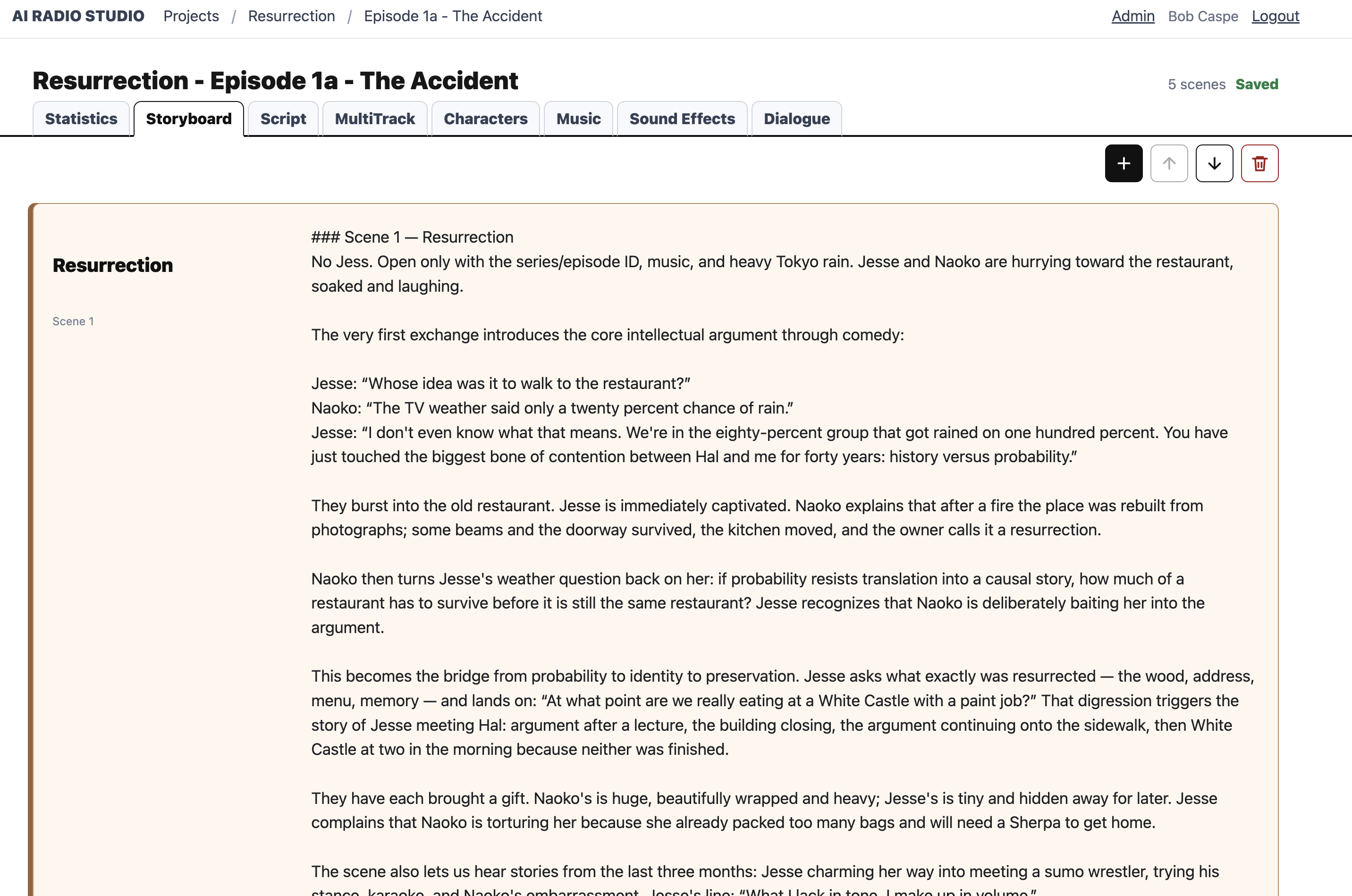
Episode 2 is planned as timed dramatic beats such as The Phone Call, The Funeral, The Scrapbook Comes Home, and Building the Archive. This is the level where I can ask whether the episode itself works before worrying about individual lines.

Music, dialogue, acting direction, timing, playback, track links, and production state live together. The script is no longer merely prose that must later be interpreted into another system.

Music, announcers, Jesse, Jess, Naoko, and SFX appear as waveform clips on the episode timeline with gain, locks, edits, and automation. The goal is not to clone Audition feature for feature; it is to make the timeline understand the same semantic objects as the script.

Characters carry baseline pace, performance style, voice choice, status, test phrases, and generation mode. Voice casting no longer has to survive as informal memory or filename archaeology.
Current voice synthesis: Studio uses Google Gemini text-to-speech for character dialogue. Jess uses the Gemini TTS voice Sulafat, with a warm, lower-register, soft performance style and a baseline pace of about 125 words per minute.

Pieces such as Echoes in the Static, Stronger Than Death, and Unresolved At Dusk are episode-scoped resources with duration, status, and playback rather than anonymous files somewhere in Dropbox.
How the music is made: Bob develops lyrics and musical direction with ChatGPT, sometimes adapting older texts or poetry, then uses Suno to generate candidate songs or instrumentals. He listens, selects, revises, and places the chosen music where it best serves the drama.
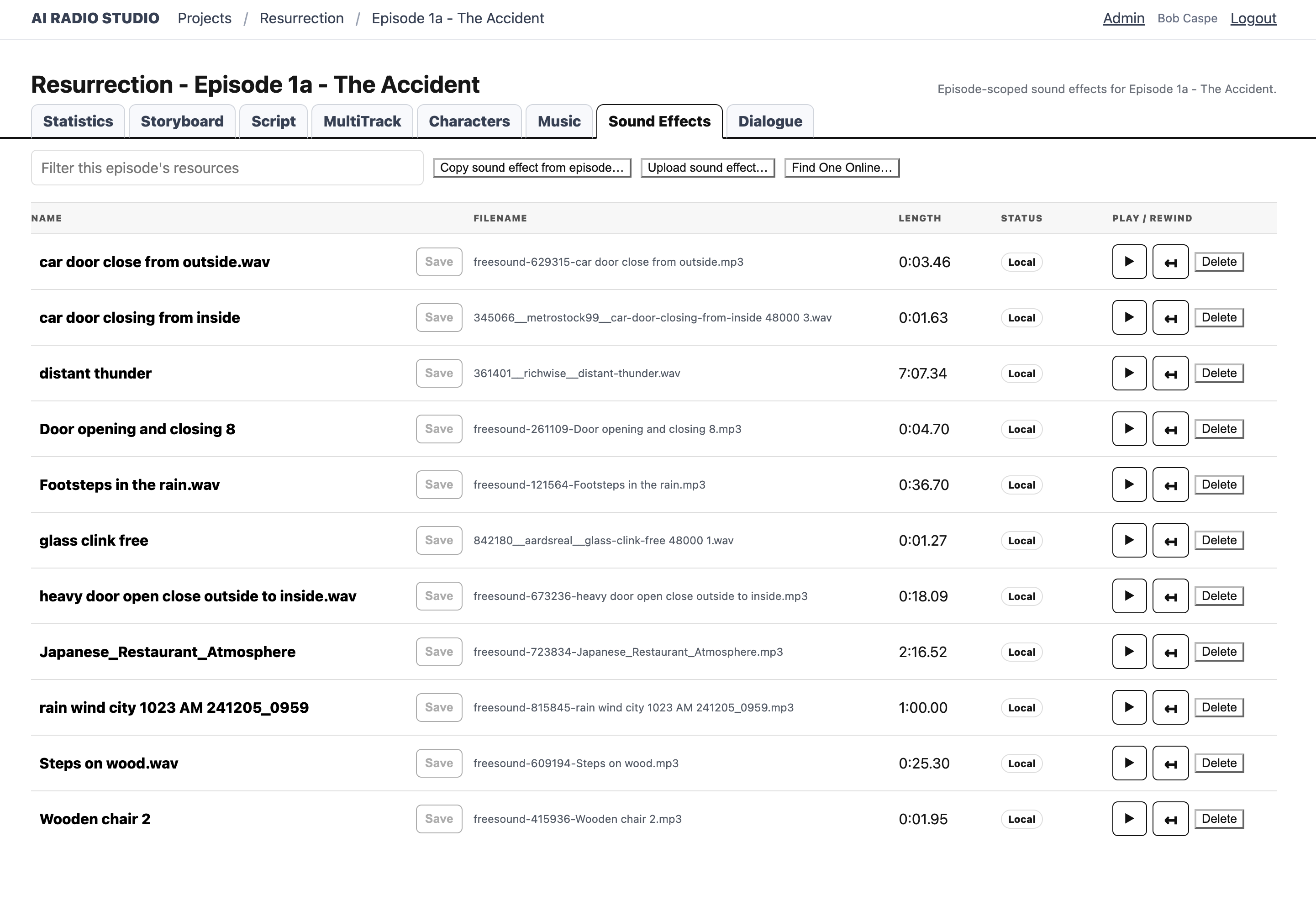
Doors, thunder, rain, footsteps, glass, restaurant atmosphere, and other effects can be searched, auditioned, copied, uploaded, and associated with the episode.

Multiple generated performances for a block are explicit managed takes with filenames, durations, status, and playback. The system can increasingly know what a take belongs to, what replaced it, and what has become obsolete.
Screenshot set captured September 8, 2026: Statistics, Storyboard, Script, MultiTrack, Characters, Music, Sound Effects, and Dialogue.
If a dramatic beat remains linked to the script blocks that realize it and the clips that realize those blocks, I can move from forest to trees and back again without losing context. That is likely to be the central Studio issue as Episode 2 begins.
Current workflow
The development diary
This chronology remains useful because neither the story process nor the tool process evolved in a straight line.
First complete version
This is version 020, the first complete assembled Episode 1. I am keeping it available because the contrast with the developing Episode 1a is part of the experiment.